-

Future-focused National Security Space Technologies to Watch in 2025
To ensure Lockheed Martin remains at the forefront of advancement across the aerospace and defense industry, we are pushing the innovative envelope in key areas including: 1. Doubling-down on Air-Space Integration In today’s complex and rapidly changing threat environment, the need for seamless integration between air and space capabilities is more critical than ever. Air-Space…
-

Webcast: The State of JADC2
This webcast took place on December 10, 2024 The Department of Defense’s Joint All-Domain Command and Control (JADC2) initiative is designed to enable communication, data sharing and decision-making capabilities across all forces. Making JADC2 a reality presents a number of challenges, including breaking down information silos, upgrading or replacing legacy equipment and ensuring networks can…
-

Apex Defense: Where Defense Meets Innovation
Apex Defense is more than just a typical defense event. Scheduled for April 23-24, 2025, at the Gaylord National Harbor, MD, this groundbreaking forum is set to redefine how the U.S. military, defense contractors, private capital and cutting-edge tech companies connect with each other. The mission is to “deliver adaptable capability at speed and scale…
-

Minnesota National Guard on the Impact of Tech for Human Performance
The Minnesota National Guard adopted the Army’s Holistic Health & Fitness (H2F) program to improve the readiness of its service members. The program aims to enhance individual readiness, reduce injuries, improve rehabilitation, and ensure soldiers are fully prepared for combat. To drive attendance at trainings and with engagement with the H2F program, the Guard partnered…
-

Webcast: AI’s Role in Role in the Future of Defense Manufacturing
As the United States military undertakes a massive modernization effort, manufacturing processes that can deliver new vehicles, weapon systems and other materiel will be critical to ensuring a force that can fight on the modern battlefield. To meet these manufacturing demands, industry is turning to artificial intelligence (AI)-driven tools. AI’s ability to analyze massive amounts…
-

Discussion at AUSA: The State of Future Vertical Lift
This event took place on October 16 at AUSA Annual 2024. The Army’s Future Vertical Lift initiative is designed to ensure forces have the capabilities, support and flexibility needed in all theaters. Whether the task is troop transport or close air support, the FVL program will need to offer several different kinds of functionality to…
-

Discussion at AUSA: Adaptation and Development of Drone Capabilities
This event took place on October 15 at AUSA Annual 2024. As drones become ever more important for reconnaissance, defensive and offensive applications, streamlining the process of developing and adapting new capabilities is critical to their most effective use. By speeding up the processes of getting drones into the hands of warfighters and incorporating their…
-

Discussion at AUSA: The Future of Air and Missile Defense
This event took place on October 15 at AUSA Annual 2024. As threats such as cheap, expendable drones and hypersonic missiles continue to proliferate, air and missile defense must adapt to meet the challenges of intercepting and destroying them. Key to doing so is an integrated air and missile defense strategy that can quickly and…
-
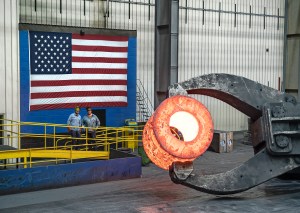
Failure to invest in forging industry jeopardizes our military edge
The United States “is like a giant boiler,” British Foreign Secretary Edward Grey is said to have remarked as America’s industrial might was brought to bear to help rescue European allies in World War I. “Once the fire is lighted under it, there is no limit to the power it can generate.” As the United…
-
‘It doesn’t get much more basic’: Why forging can’t be forgotten
The arsenal of democracy rests on America’s forging industry. More than 152 forging plants in 38 states forge the metals and alloys for warships, planes, spacecraft, combat vehicles, missiles, rockets, bombs, ammunition, artillery pieces, and much more. But collectively, they have significant untapped capacity to meet growing national defense requirements. Inefficiency and unclear demand signals…

Featured: