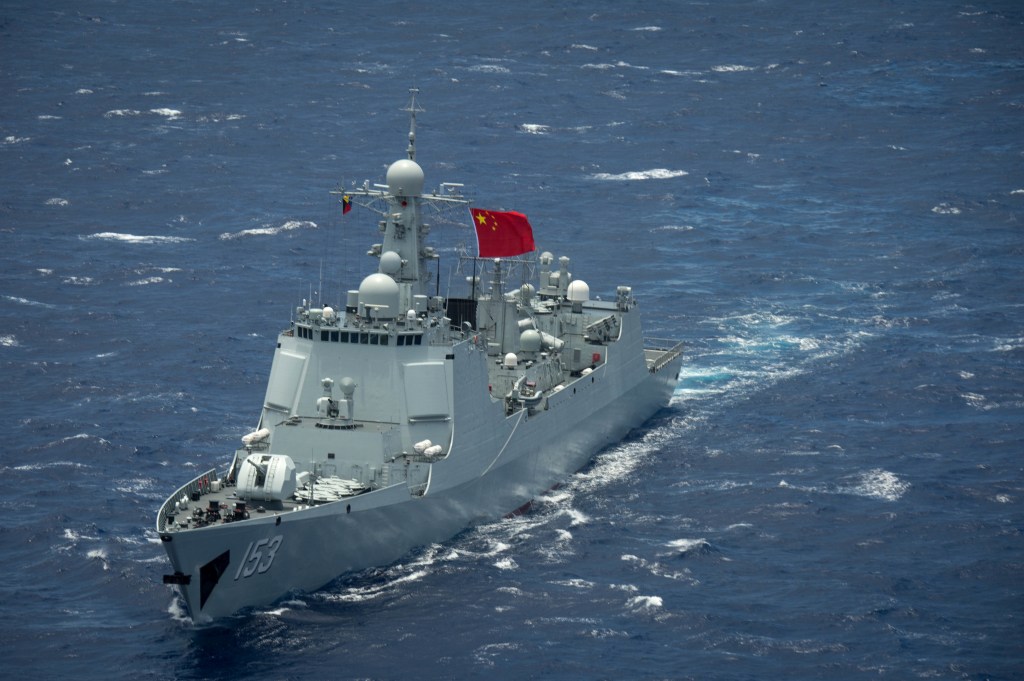
The fastest-growing navy over the past 30 years is, by far, China’s People’s Liberation Army Navy (PLAN). The fleet has discarded most of its Cold War-era ships – including many designs that dated from the 1950s and 1960s – and thousands of small, ineffective craft in favor of new, modern, ocean-going warships outfitted with increasingly sophisticated and capable weapons and sensors.
Around 60 new naval ships per year were laid down, launched or commissioned in 2014 and 2015. The balanced fleet, which includes aircraft carriers, nuclear and electric-powered submarines, modern destroyers and frigates, large amphibious ships and capable logistics ships, is aimed at backing up China’s claim as the guarantor of the “maritime silk road” — the lanes of commerce that traverse all the country’s regional waters – and supporting and enforcing China’s position in the numerous territorial disputes that dot the region. The PLAN’s rising military power is also a factor in the increasing confidence with which China is pursuing its artificial island-building program in the South China Sea and elsewhere.
Along with the Navy, China has also invested heavily in a new Coast Guard, formed in 2013 when four maritime law enforcement agencies were combined into one. As of 2016, the Chinese Coast Guard could boast 205 ships, far outpacing Japan (78 ships) and Vietnam (55). The large “white hull” Coast Guard fleet allows Chinese ships to be aggressive in at-sea encounters, where ramming and the use of fire hoses is prevalent — lowering the risk of incidents turning deadly and casting territorial disputes more in the legal domain rather than an aggressive military undertaking. Another element of increasing concern is the Maritime Militia, a force of thousands of part-time sailors and smaller craft that can be called upon to intervene in incidents where the government does not want an overt presence.
The steady growth of China’s maritime power prompted the US to move to the so-called “Pacific Pivot,” a rebalance of forces from the Atlantic to the Pacific theaters. Beginning in 2016, US Pacific Fleet carriers began to concentrate their deployments in the western Pacific, and US forces of all kinds are increasingly spending time in the South China Sea to enhance US presence and counteract China’s. The PLAN’s growth is also a major factor driving modernization and expansion of the Japanese and Vietnamese navies, among others.
This article is part of a larger Defense News 30-year anniversary project, showcasing the people, programs and innovations from the last three decades that most shaped the global security arena. Go to defensenews.com/30th to see all of our coverage.