HELSINKI — Saab is about to reap the financial reward of a state-backed defense-industrial strategy shaped under Sweden’s former Moderate government, which was ousted by the current pro-defense spending Social Democratic Party-led coalition in September 2014.
The principal dividend from the defense-industrial strategy is helping Saab (No. 30 on this year’s Top 100 list) resist the trend that is pressuring defense spending across Europe. Instead of bracing for the impact of declining orders on the home front, Saab’s sales to the domestic market are expected to grow from 45 percent of its total operating income in 2014 to around 55 percent in 2015.
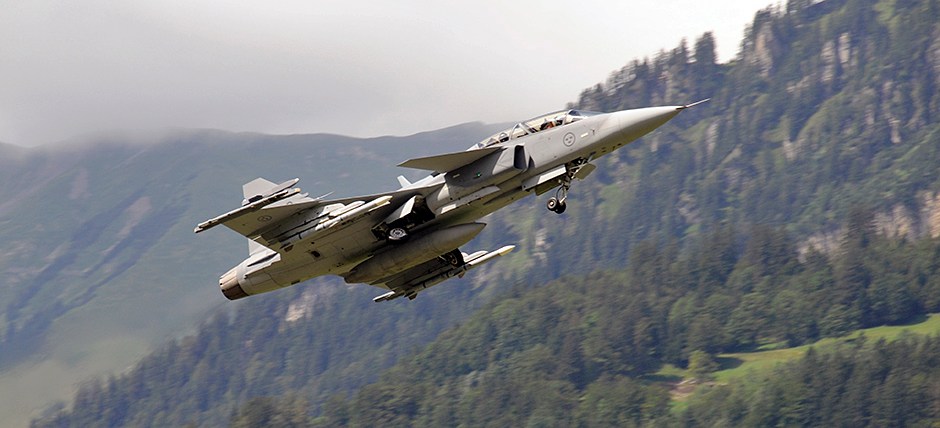
Moreover, Saab is forecasting that overall, the defense group will achieve a 5 percent increase in sales in 2015. Sweden’s decision to increase defense spending in 2016-2020, combined with big ticket contracts that include development and delivery of the Gripen-E to the Swedish Air Force and new and updated submarines for the Navy, will add a greater dynamic to the domestic contracts for Saab going forward.
By contrast, leading defense companies around Europe are seeing a contraction in their sales and order books against a backdrop of leaner defense budgets as the public spending purse tightens.
Defense companies in the UK had been anticipating a challenging year in 2015, fearing a significant drop in spending by the British government. However, there was some relief on July 8 when Chancellor George Osborne sprung a surprise, announcing in his budget speech to Parliament that defense spending will be effectively ring fenced from cuts for the rest of the decade.
The announcement was met with a collective sigh of relief within Britain’s defense industry, which had been fearing the worst after months of speculation that the military might be facing spending cuts of 7 percent or more as part of the conservative government’s austerity program.
There will be some relief in France too after the French government pledged an extra €3.8 billion ($4.1 billion) in the revised multiyear military budget, of which €1.5 billion is earmarked for acquiring equipment. A planned cut of 33,675 military personnel has also been scaled back to 14,925.
The largest single planned procurement, worth an estimated €330 million, is for four Lockheed Martin C-130 transport planes. Airbus (No. 7), shipbuilder DCNS (No. 21) and electronics specialist Thales (No. 12) are among the leading industry players that stand to benefit from the planned funding increase, with orders for combat and transport helicopters, inflight refueling aircraft, a new class of intermediate-sized frigates, and airborne laser-targeting pods.
Italy’s defense spending is continuing its downward trend as the government struggles with massive debt and a stuttering economy. This year’s MoD budget for procurement ran to €2.37 billion (US$2.6bn) with an extra €2.5 billion added by the Industry Ministry, raising the total to €4.87 billion.
Planners predict the Italian MoD’s procurement budget will drop to €1.93 billion in 2017. With many new programs on hold, local players Finmeccanica (No. 9) and Fincantieri (No. 55) were grateful this year to be awarded contracts to build eight new Navy vessels worth €4.6 billion as part of a fleet replacement plan. This plan was approved by a frugal parliament and driven in part by ongoing migrant rescue operations in the Mediterranean.
In Sweden, the socialist-led government has approved additional spending on defense of $1.2 billion in 2016-2020. This level could increase if the government decides to further upgrade air defense capabilities and establish a new air defense system on Gotland, Sweden’s most military-strategic forward island in the Baltic Sea.
For its part, Saab is set to take a bigger share of the Swedish Armed Force’s (SAF) procurement budget for 2015-2025. The Swedish government has allocated $5.7 billion to the SAF’s operating budget in 2015. Two defense projects, the Gripen-E and the Navy’s fleet modernization programs, will dominate the SAF’s procurement spend up to 2025.
Saab is the main supplier to both programs, and has been contracted to deliver up to 70 single-seat Gripen Es by 2026. The Swedish government may, depending on the future impact of regional tensions on air defense needs, scale-up this number to 80 Gripen-Es. The potential spend on the Gripen-E program, therefore, could run between $3.4 billion to $4.5 billion.
The Navy’s surface and underwater fleet reinforcement programs and related contracts will also prove highly positive for Saab’s balance sheet. Saab will design and supply two next-generation A26-type submarines and conduct mid-life upgrades (MLU) on two of the Navy’s Gotland-class subs.
Saab will also generate orders from the Navy’s planned surface fleet modernization program.
The first of the two A26-class submarines are due to be delivered in 2022 and the second in 2024. The contract value here is $883 million. The two upgraded Gotland-class submarines are due for delivery in 2018 and 2019, and including . The contract value of the Gotland-MLU, which includes an overhaul of combat systems, has a contract value of $244 million.
The contracts and growth potential for Saab driven by the defense-industrial strengthening strategy, was clearly visible in the high level of government support that attached to the group’s acquisition of Sweden-based naval ship builder ThyssenKrupp Marine Systems AB (TKMS) from German parent ThyssenKrupp in July 2014.
The $40 million acquisition of TKMS, renamed Saab Kockums, added an important underwater capability to Saab’s traditional land, air and sea offerings. The landmark deal gave Saab the yard facilities and first-time capability to design and produce submarines and surface ships for domestic and global markets.
The TKMS deal also presented a Swedish solution for a Swedish problem, meeting the need to retain specialized naval vessel building skills, technologies and expertise in Sweden while fulfilling the government’s ambition to boost cooperation within a closer defense-industrial relationship.
The larger share of spend on indigenous contracts is not only important for Saab’s future growth, but will enable the group to bolster both sales in aircraft and naval segments at a global level said, Saab’s President and CEO Håkan Buskhe said.
“We are also exploring export opportunities to provide complete submarine systems to a select number of countries, plus subsystems across the wider market,” Buskhe said.
Buoyed by aircraft and naval orders, Saab showed order bookings of $2.2 billion in the first half of 2015, representing a 134 percent increase over January-June 2014. The group’s order backlog rose by 19 percent to $7.89 billion in the same period.
Order bookings from Sweden rose massively to $1.41 billion in the first half year, up by 307 percent compared to January-June 2014. Order bookings from EU markets declined by 5 percent to $247 million in the same period, while bookings from the Americas dropped by 6 percent to $111.2 million.
Apart from Sweden, the second biggest increase in orders logged by Saab in the first half of 2015 relates to Asia, where order bookings amounted to $295 million, marking a 178 percent increase over January-June 2014.
Saab’s second-half year accounts will include income associated with the Gripen-E, A-26 and its agreement to deliver 36-NG Gripens to Brazil. Regarding the Brazil Gripen-NG project, Saab expects to book supplementary weapon deliveries valued at $245 million.
Saab signed an agreement with Brazil’s Ministry of Defense in October 2014 to deliver 36 Gripen-NGs in a deal worth around $5.4 billion.
In Britain, and despite the better-than-expected budget outcome, conditions remain tough even with the greater level of predictability for industry provided by the budgetary ring-fencing. However, UK companies with substantial operations in the US, such as like BAE Systems (No. 3), Cobham (No. 47), Ultra Electronics (No. 68) and GKN Aerospace (No. 67), should see improving market conditions.
According to Alex Ashbourne Walmsley, a consultant at Ashbourne Strategic, despite the budget settlement and recent statements by Prime Minister David Cameron about increasing ISTAR requirement, there is “not a lot of money around for new program investment, particularly when defense inflation is taken into account. Companies will have to continue to pursue lean, cost efficiency strategies to help achieve growth,” he said.
The budget submission to Parliament gave defense an 0.5 percent rise in real terms until 2020, plus access to a £1.5 billion (US $2.32 billion) cash reserve that will become available toward the end of the next five-year term to cover defense and intelligence requirements. Moreover, the MoD will also be able to keep any money it generates from efficiency gains within the military organization.
Spending on defense-related research is also under pressure. The Aerospace and Defence Industries Association of Europe is so concerned about research spending across Europe that it recently sent an open letter to European Union leaders urging a “rapid and substantial increase” after years of decline.
Of the nine British companies in the Top 100 this year only support services companies Babcock International (No. 25) and Serco (No. 43) registered revenue gains in the defense sector. The latter recording just a tiny increase.
For the UK, decisions on building four nuclear missile submarines, a fleet of Type 26 frigates, multi-mission ISTAR aircraft, remotely piloted vehicles, communications programs and new Apache attack helicopters remain among the large programs awaiting investment decisions over the period.
In France, the enlarged defense spending plans include the acquisition of a further nine General Atomics MQ-9 Reaper UAVs, which will be added to the present three units in service. Elsewhere, an additional 1,000 cyber defense staff will be hired.
However, some skepticism remains over the spending boost.
“The increase has been announced but the actual release of funds will depend on the next administration,” said Loic Tribot La Spiere, the CEO of the think tank Centre d’Etude et de Prospective Stratégique.
The French parliament has adopted the revised multiyear military budget law, which includes the increased funding, but the parliament must vote each year on making the funds available, he said.
“That annual vote leads to uncertainty,” he said. The next presidential election in France is due to take place in 2017.
Defense spending within the European Union may have continued to fall in 2014 but 14 EU nations have increased their military budgets, with France and Germany committed to boosting expenditure along with Austria, Belgium, Denmark, Estonia, Latvia, Luxemburg, Netherlands, Poland, Romania, Slovakia, Sweden and the UK.
Recent figures from NATO estimated that overall spending by NATO countries in Europe would decline this year to $227 billion, compared with $270 billion in 2014 and $269 billion in 2013.
Andrew Chuter in London, Pierre Tran in Paris and Tom Kington in Rome, contributed to this report.
Saab Earns Dividend as Europe Struggles With Budgets